
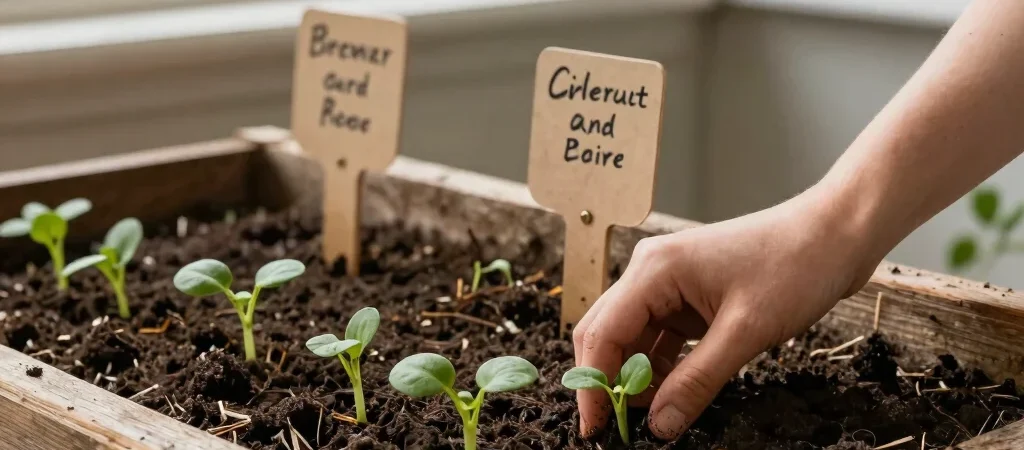
A garden changes in small increments. One day the soil looks bare; later, a green curve appears where we thought nothing was happening. Checking for those details has become one of our favorite ways to step outside the hurry of the day.
Begin With a Curious Patch
A first growing experiment can be as small as a pot, a sunny corner, or a short row that’s easy to check. Choose something suited to the light and space you actually have, then read the seed packet for its planting depth and timing. Starting modestly gives you room to learn without turning the whole yard into a test.
Labels help, especially once two rows of green begin to look remarkably alike. A wooden marker or a strip of sturdy packaging can do the job; just choose something that can handle the weather. We like writing the date down, too, because the waiting is easier when there’s a small record of what we tried.
Let the Weather Join In
A garden plan meets real conditions quickly: a stretch of dry days, a heavy shower, or a patch that gets less sun than it seemed to in spring. Rather than treating every change as a mistake, use it as information. Check the soil before watering and notice how the light moves across the space.
That kind of attention is practical, but it can also be a lovely family habit. One person spots a new leaf, another notices a drooping stem, and suddenly a quick pass through the garden takes a little longer. The small observations are part of what we’re growing.
Keep Notes for Next Time
A few honest notes can be more useful than trying to remember everything at the end of the season. Write down what was planted, where it went, and what you’d change next time. There’s no need for a beautiful garden journal; the back of a notebook is perfectly good ground for an experiment.
Not every seed will thrive, and not every plan will survive a busy week. But a garden doesn’t ask us to get everything right before we begin. Pick one small patch, pay attention to what it tells you, and let next season start with what you learned.